
RAID DATA RECOVERY EXPERTS KENYA

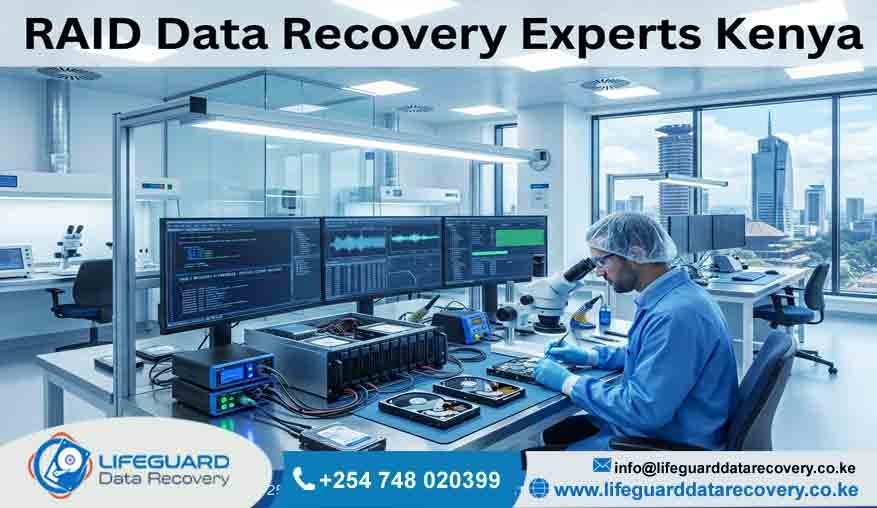
Lifeguard Data Recovery Kenya: Your Trusted Partner in Information Retrieval
Losing access to your most important digital files is a nightmare for any business or individual. RAID data recovery experts Kenya One minute everything is fine, and the next, a server in a Nairobi office fails or a personal laptop in Mombasa gets damaged. It’s a high-stakes situation. At Lifeguard Data Recovery, we specialize in fixing that gap between a total hardware crash and getting your files back. As a top choice for Data Recovery Kenya, we mix advanced lab tech with years of hands-on forensic experience to make sure your records, memories, and private info get back to you safely.
[Call Now: +254 748 020 399] | [WhatsApp Our Engineers]
No Recovery, No Charge: You only pay us if we actually get your data back.
Secure & Confidential: We follow strict privacy rules for corporate and government work.
Certified Engineers: Our techs are specialists in the deep science of storage forensics.
Fast Turnaround: We offer 24/7 emergency help for systems that just can’t stay down.
The Landscape of Digital Loss and Data Recovery Kenya
The tech world in East Africa is growing fast, and that means we are all leaning more on complex storage setups. From the busy offices in Westlands to the big factories in Thika, data is everywhere—on tiny thumb drives and massive company servers. The thing is, Data Recovery Kenya is built on the reality that losing data isn’t a “maybe,” it’s a “when.” Hardware doesn’t last forever. Things like power surges or the high humidity we often see can kill sensitive parts in a heartbeat.
When a drive dies, most people panic. That’s a mistake because it usually leads to more damage. We see people trying “free” software they found on the web, but that often just overwrites the very data they are trying to save. Our goal is to provide a stable, controlled environment where we can work on your device properly. We treat every case like an emergency. We know that for a business in Nakuru or Eldoret, being offline for even an hour means lost money and a hit to their reputation.
Our lab is built to handle the hardest jobs in the business. We don’t just click buttons on a screen; we do actual mechanical surgery in cleanroom environments. This might mean swapping out broken read/write heads or fixing failed controller chips. This complete approach to Data Recovery Kenya is why our success rate is so high. We give our clients the absolute best shot at getting every single file back where it belongs.
Specialized Expertise for Complex Server Environments
Managing data for a whole company takes a level of skill that most standard IT teams just don’t have. When a server with multiple disks fails, the job of getting that data back becomes much more difficult. This is exactly why the RAID data recovery experts Kenya are needed. We live and breathe the math behind how modern servers store data across multiple drives. If a RAID 5 or RAID 6 setup crashes, it’s not just about one disk; it’s like a massive 3D puzzle where half the pieces might be broken or missing.
Our team has spent over ten years mastering the art of fixing these virtual environments. It doesn’t matter if your company uses Dell PowerEdge, HP ProLiant, or Synology NAS boxes; we have the tools to talk to these machines at a deep, binary level. As the leading RAID data recovery experts Kenya, we make sure the original file structure stays perfect. When we hand the data back, your databases and permissions should work exactly like they did before the crash.
One of the biggest risks we see is someone trying to “rebuild” a RAID when it’s already failing. If a second drive dies while you’re trying to fix it, the whole thing could be gone forever. Businesses all over the country trust us as the RAID data recovery experts Kenya because we don’t take those risks. Instead of using standard “rebuild” commands, we clone every single drive first. We do all the heavy lifting on a safe, virtual copy so your original hardware isn’t stressed any further.
High-Success Solutions for Critical Storage Failures
If you’re facing a total system crash, you need a team that knows the local setup and the specific hurdles Kenyan businesses face. Choosing professional RAID recovery Kenya means you’re getting a service that understands technical complexity and business urgency. We’ve done it all—from fixing government databases to rescuing files for major media houses. Our engineers know their way around Windows, Linux, and macOS, plus the specialized systems used in banks and hospitals.
The road to professional RAID recovery Kenya always starts with a deep diagnostic. We don’t guess. We check the controller logs and the physical health of every single disk in the array. Usually, an array “fails” because one disk went out of sync and then a second one died shortly after. With our lab gear, we can often trick these drives back into working just long enough to pull the raw data we need to build a virtual version of your server.
We also believe in keeping you in the loop. In the real world, transparency matters, and it’s a big part of our professional RAID recovery Kenya service. You’ll get a list showing exactly which files we can save before you pay the full fee. This takes the guesswork out of the process. It gives our clients in Nairobi and the rest of the country the “No Recovery, No Charge” peace of mind they need when handling their most important projects.
Advanced Techniques for Multi-Disk Arrays
Handling big data storage isn’t just about the hardware; you have to know how the data is scattered across all those disks. When a NAS or SAN stops working, the whole company feels it. This is why people call us the RAID recovery specialists Kenya. Our tech team stays on the cutting edge, handling everything from the newest NVMe RAID setups to high-speed SSD arrays. If the controller hardware itself dies, we have the skills to manually pull the data and put it back together piece by piece.
As the top RAID recovery specialists Kenya, we see a lot of cases where someone accidentally deleted a partition or initialized a drive, making a physical failure even worse. Our software guys can actually write custom code to find specific file markers even if the main directory is totally wiped out. This forensic level of work is what makes us different from a basic repair shop. We can handle the tough stuff like XFS, EXT4, and BTRFS file systems that others won’t touch.
We help people all over the country, so help is never too far away. Our main lab is in a central spot, but we work with clients from Kisumu all the way to the coast. Being the go-to RAID recovery specialists Kenya means we have secure ways to ship your gear so it arrives safely. Once it’s with us, your drives stay in a high-security, climate-controlled zone. We make sure your company secrets and personal files stay completely private and protected.
Navigating Modern Storage Challenges in East Africa
Storage tech has changed a lot, moving from the old spinning hard drives to fast solid-state drives (SSDs). SSDs are great because they’re fast, but when they fail, they are much harder to fix. This is why so many firms look for expert RAID recovery services Kenya. Things like “Wear Leveling” and “TRIM” on an SSD mean that once data is lost, it can be erased for good very quickly. Our lab uses the latest PC-3000 Flash tools to talk directly to the memory chips, bypassing the broken controller entirely.
Using expert RAID recovery services Kenya means your business doesn’t have to play a guessing game that could end in permanent data loss. We give you a clear plan from day one. We start by making a perfect “image” of your drive so we don’t have to keep messing with the original hardware. Whether it’s a small failure in a Thika factory or a big server crash at a school in Eldoret, we have the lab power to handle it.
We are always investing in new research because digital forensics never stops changing. To remain the top provider of expert RAID recovery services Kenya, we have to keep learning. We maintain a massive library of thousands of “donor” parts—like circuit boards and head assemblies—so that even if your drive is old or rare, we probably have the parts in stock to get it spinning again and read your files.
Comprehensive Device-Specific Recovery Capabilities
RAID systems might be our most technical work, but we use the same high standards for every device that comes through our door. Data loss happens in many ways, and every device needs a different plan.
Hard Drive and SSD Recovery
Old-school hard drives (HDDs) often get the “click of death.” This usually means the internal heads have crashed. To fix this, we have to open the drive in a Class 100 Cleanroom so not even a speck of dust touches the platters. SSDs are different; they usually have “firmware” bugs or chip failures. We use special emulators to fix the drive’s internal software so we can pull the data out.
Mobile Phone and Tablet Forensics
Most of our lives are on our phones now. If you have a water-damaged iPhone in Mombasa or a smashed Android in Nairobi, we can help. We can perform “chip-off” recoveries where we take the memory chip off the board to get your photos, contacts, and messages back, even if the phone won’t turn on.
CCTV and DVR Data Retrieval
Security is a big deal for businesses in Kenya. If a security system is damaged during a fire or a break-in, that video might be your only proof. We can pull video files from these systems even if the drives were formatted or partially wiped. This is a huge help for legal cases and insurance claims.
Detailed Recovery Process and Timeline
We want you to know exactly what happens when your device is in our lab. It helps take some of the stress out of the situation. We follow a clear three-step path to get the best results.
- Evaluation and Analysis: Within 24 to 48 hours of getting your device, we do a full checkup. We find out if the problem is physical or software-based and give you a final price.
- Imaging and Repair: If you say go, we move to the cleanroom for repairs. We make a perfect clone of your drive. We do all our work on that clone to keep your original drive safe.
- Data Extraction and Verification: We dig through the clone to find your files. We’ll send you a list so you can see what’s there. Once you pay, we put your data on a new drive and get it back to you.
How long it takes depends on the damage. A simple software fix might take 2 or 3 days. A big RAID job where we need to find rare parts might take a week. If you’re in a huge rush, we have “Emergency” levels to get you back online even faster.
Case Study: Recovering an 8-Bay NAS for a Nairobi Media Agency
The Problem: A big ad agency in Nairobi got hit by a power surge during a storm. Their 8-bay Synology server stopped working. Their IT guy tried to swap a drive to fix it, but it just made the system crash harder. They had 20TB of video edits and client files that they couldn’t reach.
The Challenge: Two of the drives had physical “bad sectors” right where the index of the files was stored. Because of the failed repair attempt, the drives were out of sync. Standard tools couldn’t even see that there were files on the disks.
The Solution: Our team at Lifeguard Data Recovery Kenya stabilized the two broken drives using our special lab gear. We figured out how the data was striped across the disks by looking at the raw code. We then built a “virtual” version of their server in our lab, which let us bypass the broken Synology hardware entirely.
The Result: We got 100% of their project files back in just 4 days. The agency got back to work, and we even helped them set up a better, encrypted backup so this wouldn’t happen again.
Security, Confidentiality, and Cost Factors
We know the data we touch is private. Whether it’s bank records or family photos, we make sure it stays safe. Our lab is watched 24/7, and we follow international rules for data protection. Your files never go onto the public internet or leave our secure network.
When it comes to money, we believe in being fair and clear. The price depends on a few things:
The Physical Shape of the Drive: If we have to use the cleanroom and buy parts, it costs more than a software fix.
How Much Data and How Many Disks: A 24-disk server takes a lot more work than one laptop drive.
How Fast You Need It: Emergency work means our engineers work overtime to get you sorted.
We give you the exact price after the first checkup, so there are no surprises later. Our “No Recovery, No Fee” promise means we are motivated to win—we only get paid when you get your files back.
Frequently Asked Questions (FAQs)
How long does the typical recovery process take? Most jobs take about 3 to 5 business days. If your drive is very badly damaged or if we have to order a very specific part from overseas, it might take a bit longer. We will always call you and let you know exactly where we are in the process.
What should I do if my RAID server starts making a clicking sound? Turn it off immediately! Pull the plug. That clicking is usually the sound of the internal parts breaking. If you keep it running, those parts will scrape the data off the disks, and then no one in the world will be able to help you.
Is it possible to recover data from a drive that has been formatted? Yes, usually. Formatting usually just wipes the “map” of the drive, but the data is still there. The most important thing is to stop using the drive. If you keep saving new files, you will overwrite the old ones, and then they really are gone.
Can you perform recovery on encrypted drives or BitLocker volumes? We can. As long as the parts of the drive that hold the encryption info aren’t totally destroyed, we can pull the data. You will just need to give us the password or recovery key once we’ve finished the physical part of the repair.
Do you offer a guarantee that all my files will be recovered? We have a 99% success rate, but we can’t perform miracles if the hardware is pulverized. If the magnetic layer is physically gone, the data is gone. But because of our “No Recovery, No Charge” policy, you don’t lose anything if we can’t get it.
Do I need to send the entire server or just the hard drives? Usually, we just need the hard drives. It helps a lot if you put a piece of tape on them and number them (1, 2, 3…) so we know which slot they came from. If the whole server box is broken, you can send that too, and we’ll handle it.
Your Solution for Professional Data Recovery Kenya
The second you realize your files are missing is when you should give us a call. Don’t risk your data by letting an amateur “try” to fix it. Whether it’s a virus, a dropped drive, or a server that just won’t boot, our lab can handle the pressure. We are proud to be the top name in Data Recovery Kenya, bringing world-class tech to our local neighbors and businesses.
Your data is your hard work and your history. Every second a broken drive stays powered on, the chance of saving it drops. By picking our team, you get a proven track record and a group of people who will work tirelessly to get your digital life back on track.
[Contact Lifeguard Data Recovery Kenya Today]
The danger of losing your data forever is real. Don’t wait until it’s too late. Give us a call for a free consultation, and we will walk you through exactly how we can help you get your files back.
📞 +254 748 020 399 📧 info@lifeguarddatarecovery.com 📍 Serving Nairobi, Mombasa, Kisumu, Nakuru, and all of Kenya.