
RAID Recovery Experts Kenya

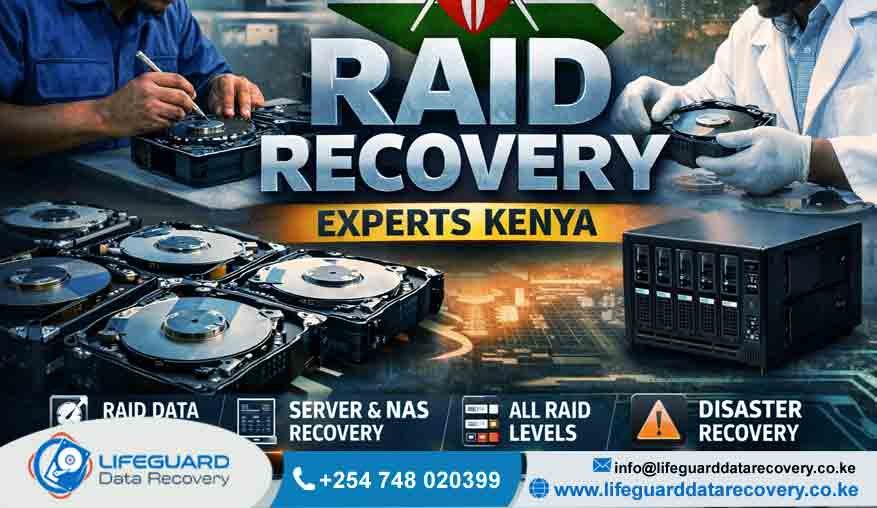
Certified RAID Recovery Experts Kenya: Restoring Critical Server Data
When a high-capacity server array suddenly goes offline, the silence in the server room is absolutely deafening. For an IT manager in the heart of Nairobi or a logistics coordinator in Mombasa, a RAID failure isn’t just a technical setback; it is a full-scale operational emergency that threatens the very survival of the business. We understand that every second of downtime erodes your bottom line,
Think of our laboratory as the digital intensive care unit for your data. We don’t just “fix” drives; we perform low-level hardware repairs and custom software reconstruction to bypass mechanical failures that stop ordinary computers. This level of technical dominance has made us the trusted partner for government agencies, financial institutions, and corporate giants across the region. When the “Red Light of Death” appears on your server rack, we provide the calm, expert intervention required to bring your business back to life.
[Call Now: +254 748 020 399] | [WhatsApp Emergency Support]
- No Recovery No Charge
- Secure & Confidential
- Certified Engineers
- Fast Turnaround
Why Trust Our RAID Recovery Experts Kenya With Your Enterprise Servers?
Choosing the right partner for your server emergency is a decision that will define your company’s recovery timeline. We maintain a state-of-the-art Class 100 Cleanroom, which is an absolute necessity for opening the member disks of a RAID array. Without this controlled environment, a single microscopic dust particle can cause a head crash, turning a recoverable situation into a permanent disaster.
The truth is, RAID reconstruction is more of an art than a simple procedure.
We also believe in a risk-free partnership, which is why we strictly adhere to a “No Recovery, No Charge” policy. If our experts cannot retrieve your critical business data, you do not pay the engineering fee. In the high-stakes world of enterprise storage, we provide the certainty and expertise your board of directors demands.
Specialized RAID data recovery Kenya: Solving Multi-Drive Failures
When a system experiences multiple disk failures simultaneously, the internal logic of the array collapses. We provide specialized RAID data recovery Kenya that focuses on these catastrophic “multi-point” failures. Whether you are dealing with a RAID 5 array where the second drive died during a rebuild or a RAID 10 system with synchronized head crashes, we have the forensic imaging tools to stabilize the physical media and extract every readable sector.
The local business landscape in Nairobi often relies on RAID 5 for its balance of speed and storage, but it is incredibly vulnerable during the “rebuild” phase. Many IT teams in Kenya have learned the hard way that a second drive failure during a parity check is more common than one might think. We specialize in finding the “stale” data and the most recent parity blocks to stitch your files back together, even when the original hardware says the array is “dead.”
Our expertise isn’t limited to the physical drives themselves; we also tackle the logical side of the disaster. We understand the specific file structures of SQL databases, Exchange servers, and ERP systems, allowing us to verify the health of your most important applications before we consider the job done.
Fast RAID recovery services Nairobi: Mirroring and Boot Partition Restoration
For smaller businesses in the capital, a mirrored setup is often the primary line of defense. Our RAID recovery services Nairobi provide rapid intervention for RAID 1 failures, which often occur when the hardware controller itself malfunctions. By utilizing our local presence, we can offer same-day diagnostics for many cases, getting your accounting software or creative projects back in your hands before the end of the business day.
High-Security Professional RAID recovery Kenya: Double Parity Reconstruction
Large-scale firms and data centers increasingly rely on double parity for added safety, yet even these systems fail. We provide Professional RAID recovery Kenya for RAID 6 configurations, which are technically much more difficult to reconstruct than standard arrays. When a RAID 6 array goes down, it usually involves complex block-level corruption that requires manual hex-editing and custom parity mapping. Our engineers are among the few in East Africa with the skills to handle these high-level forensic tasks.
In the DIFC-equivalent zones and corporate headquarters of Nairobi, the stakes for RAID 6 recovery couldn’t be higher. We treat these cases with a specialized workflow that includes priority 24/7 engineering. We understand the math behind Reed-Solomon coding and the various proprietary parity implementations used by different manufacturers. This deep technical knowledge ensures that your most resilient systems are in the best possible hands when the unthinkable happens.
RAID server recovery Kenya for Modern Storage Systems
As office environments evolve, the use of Network Attached Storage (NAS) has skyrocketed. We provide expert RAID server recovery Kenya for devices from Synology, QNAP, Buffalo, and Western Digital. These devices often use Linux-based MDADM or LVM2 configurations that standard Windows-based repair tools simply cannot read. Our lab is equipped with specialized Linux forensic stations designed to mount these proprietary file systems and extract data without altering the original disk structure.
The truth is, many NAS failures are caused by more than just disk health. Firmware updates gone wrong or power fluctuations in Mombasa’s industrial areas can corrupt the internal operating system of the NAS, making the RAID volume inaccessible. We can extract the raw data from the member disks and virtually reconstruct the volume on our own servers.
Whether your NAS is a small 2-bay unit in a home office or a 12-bay rackmount system in a corporate data center, the recovery principles remain the same: preserve the hardware, clone the data, and rebuild the logic. We have a massive library of donor motherboards and power supplies for major NAS brands, ensuring that if we need to put the drives back into an identical “clean” unit to verify the recovery, we have the resources locally available to do so immediately.
High-Level RAID 0 recovery Kenya: SAN and Virtualized Environments
For organizations that prioritize performance, RAID 0 or “striping” is often used, but it offers zero redundancy. We offer specialized RAID 0 recovery Kenya to address the absolute loss that occurs when even a single drive in a stripe set fails. In these cases, there is no parity to help us; we must physically repair the failed drive to a 100% functional state just to have a chance at seeing the data. This is the most technically demanding form of recovery, and it is where our cleanroom expertise truly shines.
In larger enterprise environments, we often deal with SAN (Storage Area Networks) and virtualized layers like VMware and Hyper-V. Recovering a RAID 0 stripe that contains a massive VMDK file requires a massive amount of processing power and surgical precision. We can reconstruct the underlying RAID stripe and then “tunnel” through the virtual file system to find the specific files you need. This multi-layered recovery approach is what defines us as the leaders in the Kenyan enterprise market.
Our team is also proficient in dealing with “nested” RAIDs like RAID 10 or RAID 50. These systems combine the speed of striping with the safety of mirroring or parity, but they are a nightmare to recover when multiple sub-arrays fail. We treat these as a series of interconnected puzzles, solving each sub-array before integrating them into the final, usable volume. If your data center in Nairobi or Eldoret is facing a nested RAID collapse, we have the technical roadmap to guide you back to safety.
Our 3-Step Server Restoration Process
At Lifeguard Data Recovery, we follow a transparent and scientific workflow to ensure the highest possible success rate for your server. We treat every member disk of your array as a critical piece of a larger puzzle. From the moment we pick up your hardware in Mombasa to the final verification in our Nairobi lab, your data is handled with a level of forensic care that is unmatched in the region.
Phase 1: Emergency RAID server recovery Kenya Diagnosis
The first step is a comprehensive evaluation of every physical drive in the array. We don’t just “plug them in”; we use hardware write-blockers and forensic imagers to check the health of the platters and the electronics. Our RAID server recovery Kenya diagnosis identifies exactly which drives have failed and whether the issue is a physical head crash, a firmware lock, or an electronic failure. We provide you with a full report and a fixed price before we move to the extraction phase.
Phase 2: Advanced RAID data recovery Kenya & Parity Rebuild
Once the physical drives are stabilized and cloned, our engineers begin the virtual reconstruction. During this RAID data recovery Kenya phase, we determine the stripe size, rotation, and offset of the original array. If a drive is missing, we use the parity blocks from the healthy disks to “calculate” the missing data in real-time. This is performed entirely in RAM or on high-speed SSD scratch disks to ensure that your data is rebuilt with bit-level accuracy without further stressing your original hardware.
Phase 3: Secure Professional RAID recovery Kenya Data Verification
Before we hand the data back, we perform a deep integrity check. Our Professional RAID recovery Kenya verification involves checking the most critical files—such as your SQL databases or large CAD files—to ensure they aren’t just “present” but are actually functional. We then copy the recovered data to a brand-new, secure drive or an encrypted cloud link. We provide your IT team with a file list for approval, ensuring that the recovery meets your business requirements before final delivery.
Devices & RAID Configurations We Recover in Kenya
Our expertise covers the entire spectrum of RAID technology, from legacy SCSI arrays to the latest NVMe server clusters. We handle all major brands including Dell PowerEdge, HP ProLiant, IBM System x, and Cisco UCS. We also support all RAID levels (0, 1, 5, 6, 10, 50, 60) and proprietary configurations like Synology Hybrid RAID (SHR) and Drobo BeyondRAID.
- RAID Controllers: Adaptec, LSI, MegaRAID, Dell PERC, HP Smart Array.
- Drives: SAS, SATA, SCSI, NVMe, SSD, Fibre Channel.
- OS/File Systems: NTFS, ReFS, EXT4, XFS, VMFS, ZFS, BTRFS.
Precision RAID 0 recovery Kenya for Workstations & Small Offices
Many high-end creative workstations in Nairobi use striping for video editing or 3D rendering. We provide precision RAID 0 recovery Kenya for these environments, focusing on the rapid repair of failed member disks. Because there is no redundancy, the margin for error is zero. We use proprietary tools to synchronize the data blocks across the stripe, ensuring that large media files are recovered without “glitches” or frame drops.
For a small office in Thika or Eldoret, a RAID 0 failure can feel like a total loss of work. We treat these cases with extreme urgency, knowing that the lack of parity makes the hardware repair the only path to success. Our lab maintains an extensive inventory of donor parts for all major HDD and SSD brands, allowing us to perform the necessary “organ transplants” on your drives immediately to begin the recovery process.
Critical RAID server recovery Kenya for Data Center Integrity
Data centers are the heart of Kenya’s digital economy, and their integrity is our top priority. Our RAID server recovery Kenya services for data centers focus on minimizing the “Blast Radius” of a failure. We work with your system administrators to understand the specific block-level configuration of your SAN or NAS. This collaborative approach allows us to target the most critical volumes first, potentially getting your most important services back online while the rest of the data is being processed.
We understand the pressure of a data center outage. Our engineers are available for on-site consultation in Nairobi to assist with drive removal and initial assessment. Once in the lab, your data is treated as a high-priority case, with dedicated resources assigned to ensure a fast turnaround. We provide the technical assurance that your data center can recover from even the most complex multi-disk failures.
Common Server Failures We Solve: Beyond Controller Errors
Most people think a RAID failure is just a bad drive, but the reality is often more complex. A common scenario is “Rebuild Failure,” where a secondary drive has hidden bad sectors that only reveal themselves when the system tries to read the entire disk during a parity rebuild. This “Stale Parity” issue can lead to massive data corruption if handled by standard software. We manually analyze the metadata to identify the most recent data blocks, avoiding the “junk” data that a forced rebuild might introduce.
We also tackle electronic failures, such as power surges that fry the RAID controller and the PCBs of all member disks simultaneously. In these cases, we must repair every single drive in the array before we can even begin to look at the data. Other common issues include accidental deletion of the RAID configuration in the BIOS, formatted logical volumes, and firmware “loops” where the drives are busy but inaccessible. No matter the cause, we have the tools to see through the error codes and find your data.
Transparent Pricing for High-Stakes Server Recovery
Pricing for RAID recovery is based on the complexity of the engineering required, not the amount of data recovered. Factors include the total number of drives in the array, the specific RAID level, and the physical condition of the failed disks. For example, a RAID 5 with one physically crashed drive is a different technical challenge than a RAID 6 with two firmware-locked drives. We provide a transparent, fixed quote after the initial diagnostic, so there are no surprises for your procurement department.
We also offer different service levels to match your budget and urgency. Our “Emergency” service provides round-the-clock engineering for critical outages, while our “Standard” service offers a more cost-effective path for non-urgent backups. Regardless of the level you choose, the quality of our cleanroom work and the security of your data remain the same. We provide the best ROI for your recovery budget by ensuring the highest possible success rate on the first attempt.
Expert Advice: What to Do When Your RAID Array Fails
The actions your IT team takes in the first 30 minutes of a failure will determine if the data is recoverable. The most important rule is: Stop the rebuild. If your RAID controller begins a rebuild and then encounters another error, do not try to “force” it online. This often leads to the controller overwriting good data with zeroes or garbage parity. Power down the server immediately to prevent further mechanical wear on the disks.
When preparing the drives for transport to our lab, clearly mark their original positions (Drive 0, Drive 1, etc.) in the bays. This information is vital for our engineers to reconstruct the stripe order correctly. Do not swap drives between different bays or try to “re-seat” them multiple times. If the drive is making a clicking or grinding noise, it is a physical failure that no software will ever fix. Contact us immediately for a secure pickup and let our laboratory experts handle the delicate work of physical stabilization.
Why Lifeguard is the #1 Choice for RAID Recovery Experts Kenya
Lifeguard Data Recovery has earned its position as the top RAID Recovery Experts Kenya by consistently delivering results where others have failed. We are the only lab in the region with the specific combination of Class 100 Cleanroom technology and advanced RAID de-striping hardware. Our success stories span every sector of the Kenyan economy, from rescuing the financial records of a Nairobi bank to restoring the research data of an international NGO. We don’t just provide a service; we provide a lifeline for your organization.
Our team is deeply rooted in the local community, serving all 47 counties with a focus on the major hubs of Nairobi, Mombasa, Kisumu, and Nakuru. We understand the unique challenges of the Kenyan environment, from power instability to the high humidity of the coast, and we have built our lab to withstand these factors. Our “No Recovery, No Fee” commitment is our promise to you that we will treat your data with the same urgency and care as you would.
When you choose Lifeguard, you are choosing a partner that understands the business impact of data loss. We provide clear, professional communication throughout the process, giving your IT department the technical details they need and your management the timeline they require. We are the experts that other IT companies call when they run into a wall. Trust the professionals who have saved thousands of businesses across East Africa.
Case Study: 12-Bay RAID recovery services Nairobi for a Kisumu Hospital
A major hospital in Kisumu recently faced a catastrophic failure of their primary patient record server—a 12-bay RAID 6 array. Three drives had failed in rapid succession due to a cooling system failure in their server room. The hospital’s backup system had failed to trigger, leaving ten years of medical history, X-rays, and billing data inaccessible. The situation was critical, as doctors were unable to access patient histories for ongoing treatments.
The array was transported to our Nairobi lab under high security. Our engineers found that two of the drives had physical head crashes, while the third had a corrupted firmware module. We performed successful head swaps on the two mechanical failures and repaired the firmware on the third in our cleanroom. Once all 12 drives were imaged, we manually recalculated the double parity to account for the block-level corruption caused by the heat.
The result was a 100% recovery of the hospital’s database. We delivered the data on a secure encrypted volume within 72 hours, allowing the hospital to resume full operations. This case highlights why we are the preferred RAID recovery services Nairobi provider for mission-critical infrastructure. Our ability to handle physical hardware repair and complex logical reconstruction simultaneously saved a decade of vital medical information.
Frequently Asked Questions (Server & RAID Focus)
Is RAID 5 recovery Kenya possible if two drives have failed?
Yes, RAID 5 recovery Kenya is absolutely possible even if two or more drives have failed, but it requires a laboratory intervention. While a RAID 5 array can only “tolerate” one failure while running, our engineers can physically repair the second failed drive in our cleanroom to a readable state. Once we have a bit-level clone of that second drive, we can integrate it back into the virtual array and reconstruct your data. This is a common scenario we solve for businesses in Nairobi and Mombasa who experience “rebuild crashes.”
How long does Professional RAID recovery Kenya typically take?
The timeline for Professional RAID recovery Kenya depends on the nature of the failure. A logical recovery or a simple controller failure can often be completed within 2 to 3 business days. However, if multiple drives require physical head swaps or platter cleaning in our cleanroom, the process can take 5 to 7 days due to the delicate nature of the work and the need to source identical donor parts. We provide an “Emergency” service tier for situations where every hour counts, ensuring your case is the first one our engineers work on every morning.
Can you perform RAID recovery services Nairobi remotely?
We generally do not recommend remote recovery for failed RAID arrays because if there is an underlying physical issue with a drive, running software over the network can cause permanent platter damage. For the safest and most reliable RAID recovery services Nairobi, the drives should be evaluated in our physical lab. We provide secure courier pickups to make this as easy as possible for your team. Our laboratory approach ensures that we are working on a clone of your data, protecting your original hardware from any further risk of loss.
What makes you the top RAID data recovery Kenya specialists?
What sets us apart as the top RAID data recovery Kenya specialists is our investment in proprietary hardware and our ISO-certified cleanroom. Most local IT shops use “off-the-shelf” software that can only handle basic logical issues. We use professional forensic tools that can communicate with drive firmware and bypass faulty sectors. Additionally, our “No Recovery, No Fee” policy and our extensive experience with enterprise-grade SAN and NAS systems give our clients the confidence that they are receiving the best technical service available in East Africa.
Do you handle encrypted RAID volumes?
Yes, we have a high success rate with encrypted RAID volumes, including those using BitLocker, VeraCrypt, or hardware-level AES encryption. During the RAID recovery services Nairobi process, we first reconstruct the raw striped volume. Once the volume is “built,” we then use your decryption keys or recovery certificates to unlock the data layer. Our secure environment ensures that your keys and your data remain confidential throughout the entire process, maintaining your organization’s security posture.
What information do you need before starting a recovery?
To provide the fastest Professional RAID recovery Kenya service, we need to know the RAID level (e.g., RAID 5, RAID 10), the number of drives in the array, and the events leading up to the failure. Information such as the stripe size and the drive order in the bays is also incredibly helpful. Most importantly, we need to know if any “rebuild” or “initialize” commands were run after the crash. This technical context allows our engineers to choose the right strategy from the very beginning, maximizing the chances of a perfect recovery.
Contact the RAID Recovery Experts Kenya for Immediate Assistance
If your server has failed, do not wait for a miracle—contact the RAID Recovery Experts Kenya today. At Lifeguard Data Recovery, we have the tools, the cleanroom, and the expertise to handle the most catastrophic storage disasters. Every minute your server is offline, your business is losing valuable time and data integrity. Our team is standing by to provide a free, high-level consultation and a secure pickup from your location in Nairobi, Mombasa, Nakuru, or beyond.
We are committed to providing a professional, secure, and transparent service that gets your business back to work. Don’t trust your enterprise data to anyone but the specialists. We are the team that local IT managers rely on when everything is on the line. Contact us now to begin the recovery process and experience the peace of mind that comes with working with the best in the industry.
Your data is your organization’s most valuable asset—let us help you protect it. From small office NAS units to massive corporate data centers, we provide the same level of forensic excellence and commitment to success. Choose the experts who understand the complexity of RAID and the urgency of your business. Lifeguard Data Recovery is here to turn your digital disaster into a successful restoration.
3-Line Urgency Message: A RAID failure is a race against time; every unguided “rebuild” attempt significantly decreases the chances of a successful recovery. Professional cleanroom intervention is the only safe way to handle multiple drive failures in a server array. Secure your company’s continuity by contacting Lifeguard Data Recovery for an emergency assessment right now.
Contact Details: +254 748 020 399
EMAIL: info@lifeguarddatarecovery.com
Website: https://lifeguarddatarecovery.co.ke
Locations Served: Nairobi, Mombasa, Kisumu, Nakuru, Eldoret, Thika, and all of Kenya.