
Recover Files from Damaged RAID Arrays in Kenya

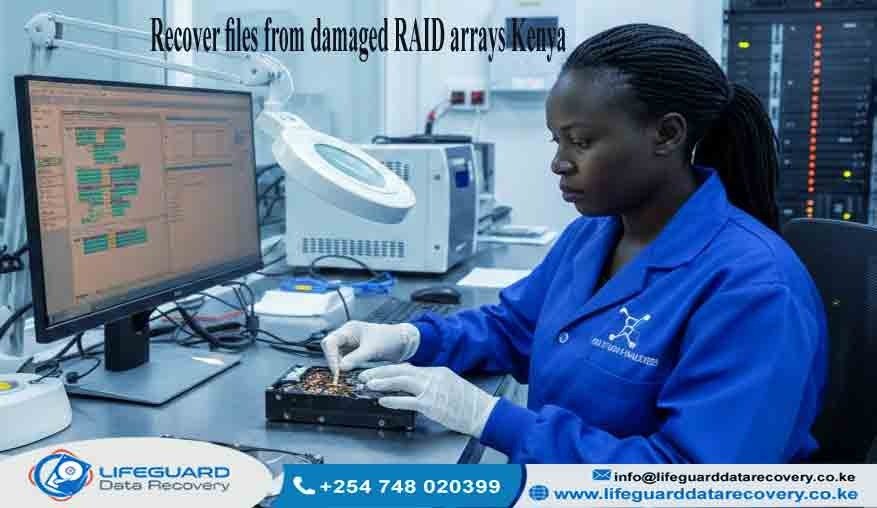
Losing data in a RAID environment isn’t just a small technical glitch; it is a full-blown business emergency that can freeze operations for your entire team. Whether your server room in Nairobi just took a hit from a sudden power surge or your NAS in Mombasa won’t mount because multiple drives failed at once, the threat of losing everything for good is very real. At Lifeguard Data Recovery Kenya, we step in when complex storage failures require high-level intervention.
Our certified engineers live and breathe the complicated parity and striping logic needed to put failing systems back together. We operate out of a secure, laboratory-grade facility to make sure your sensitive corporate files are treated with total privacy. If your RAID 0, 1, 5, 6, or 10 setup has collapsed, please don’t try a DIY rebuild. Most of the time, that just leads to permanent parity corruption that no one can fix.
[Call Now: +254 748 020 399] | [WhatsApp Our Engineers]
Our Promise to You:
- No Recovery, No Charge: You only pay us if we actually get your data back.
- Secure & Confidential: We use NDA-backed workflows for corporate and government clients.
- Certified Engineers: We have specialized training in controller emulation and file system repair.
- Fast Turnaround: We offer 24/7 emergency help for servers that simply cannot stay offline.
The Critical Importance of Specialized RAID Data Recovery Kenya
When a RAID array goes down, fixing it is a lot harder than just repairing a single hard drive. The math behind it is heavy. Data is spread across several disks using specific algorithms, and if one piece of the puzzle is missing, the whole thing breaks. In Kenya, businesses deal with specific headaches like unstable power grids or the salty, humid air in places like Mombasa. These factors often cause multiple components to fail at the same time. Turning to a general IT guy for this is risky; you need a lab with the right gear.
RAID Data Recovery Kenya is about understanding the “brain” of the system. We know how different controllers—like those from Dell PERC, HP, or IBM—handle data blocks. When a controller dies, the map that tells the system how to find your files usually disappears. Our team uses our own specialized software to trick the drives into thinking the controller is still there. This lets us rebuild the array virtually, so we don’t have to mess with the original hardware and risk more damage.
We also do a lot of work for the tech scenes in Nakuru and Eldoret. Startups there rely on centralized storage to keep things moving. A single drive failure in a RAID 5 is usually fine, but the “rebuild” process is a massive strain on the remaining old drives. If a second one hits a wall during that window, everything vanishes. Our lab protocols make sure we clone every single healthy sector first. It’s a safety net that most in-house IT departments just don’t have the tools to create.
Advanced Techniques for Damaged RAID Recovery Kenya
Physical hardware failure is usually the main reason these arrays collapse. Inside our ISO-certified cleanroom, we deal with the “bloody” side of data loss—things like head crashes, seized motors, and fried circuit boards. When a drive in your array starts making a clicking sound or won’t spin at all, it has to be opened in a sterile environment. Even a tiny speck of dust can act like a speed bump and destroy the data on the platters forever. This level of precision is what we bring to the table.
For Damaged RAID Recovery Kenya, we look past the physical metal and plastic and dig into the logical data layers. Sometimes the drives are physically perfect, but the “parity”—the mathematical glue holding the RAID together—gets scrambled. This happens after a bad rebuild attempt, a firmware update gone wrong, or a sudden crash. Our engineers manually line up the data blocks again to make sure the file system actually makes sense when we put it back together.
We are also fully equipped for the new world of SSD-based RAID and NVMe setups. They are lightning-fast, but they are a nightmare to recover because of things like “wear leveling” and built-in encryption. Whether you are running an old-school SCSI server or a brand-new 10GbE All-Flash NAS, we have the hardware to talk directly to the drives. We bypass the normal operating system to pull the raw data out before it’s too late.
Expert Solutions for RAID Server Recovery Kenya
Servers are the silent engines of Kenya’s economy. They run everything from bank apps to farm supply databases. When these systems go dark, the money stops moving. Our high-priority service is built for these high-stakes moments to keep your downtime as short as possible. We handle the big stuff—large-scale SAN systems and high-density rack servers that hold the lifeblood of your company.
Choosing RAID Server Recovery Kenya means you get a partner who knows the “language” of your data, whether it’s NTFS, ReFS, or Linux-based systems like XFS. Often, we get called in after someone tried to “force” a drive back online and made the data alignment even worse. We do a deep dive into the code to find the right stripe size. This is the only way to mount the volume virtually and get back your SQL databases or Virtual Machines.
It’s not just about office files, either. We do a lot of work with CCTV and surveillance servers in high-security spots like Nairobi malls or the Port of Mombasa. Video evidence is usually stored on RAID for safety, but if the server fails, that footage is trapped. We can find the fragments of video and piece them back together for legal cases or internal checks. We keep everything strictly documented so the evidence stays valid.
Comprehensive Guide to Recovering Files from Damaged RAID Arrays in Kenya
Getting your data back starts with a very careful diagnostic phase. We treat every RAID array like a custom-built puzzle. The first goal is to stabilize each individual disk. Think about a 12-disk RAID 6. If three disks have died, we have to get a perfect copy of at least ten of them to see your files again. We use imaging tools that can “force” their way past bad sectors that would make a normal computer freeze up or crash.
To Recover Files from Damaged RAID Arrays in Kenya the right way, we also have to watch out for “stale data.” This is a silent killer. It happens when one drive failed weeks ago and no one noticed. If we use that old, out-of-sync drive to rebuild the data today, your files will be a mess of corruption. Our engineers check the timestamps on the disk metadata to find out which drives are actually current, ensuring the files we give back to you are the latest versions.
After the hardware and parity issues are handled, we move to the final recovery stage. We scan the virtual array to find your folders. If files were accidentally deleted or hit by a virus, the “headers” might be broken. We use “file carving” to spot the unique digital signatures of your documents and photos to put them back together. This multi-step approach is why we can get results even when things look hopeless.
Detailed Data Recovery Process: Step-by-Step
Phase 1: Consultation and Secure Logistics
The clock starts the moment you call us. We’ll give you an initial idea of what’s wrong over the phone and help you get the drives to our lab safely. For clients in Thika or Kisumu, we’ll walk you through how to pack the drives so they don’t get bounced around and damaged further during the trip to Nairobi.
Phase 2: Diagnostic Evaluation
Once the drives land in our lab, they go straight to a diagnostic station. We check the boards for electrical damage and the internals for mechanical health. We then send you a full report. You’ll know exactly what happened, how much we can get back, and exactly what the bill will be before we start the real work.
Phase 3: The Reconstruction
This is where the heavy lifting happens. We make bit-for-bit clones of your media so we aren’t working on your original disks. Then, we use our software to figure out the original settings:
- Stripe Size: How the data was chopped up.
- Parity Rotation: The pattern the controller used to write.
- Disk Order: The exact sequence the drives were in.
Phase 4: Data Validation and Delivery
Once we have the data, we don’t just send it and hope for the best. We provide a file list for you to check. You can see for yourself that your most important folders are there. After you give us the green light, we encrypt the data and put it on a fresh drive or a secure cloud link for you to download.
Common Causes of Data Loss in Kenya
In Kenya, the environment is often the biggest enemy of your data. Power surges can fry the chips on your RAID controller or the tiny motors inside the hard drives. In Nairobi’s busy business districts, power can cut out in a second. If your RAID doesn’t have a good battery backup, you get what we call a “write hole.” This means the system was halfway through writing a file when the lights went out, leaving the whole file system in a state of confusion.
Then there is the “Hot Spare” trap. A lot of IT managers in Kenya think they are safe because they have a spare drive waiting in the server. But if that drive has been spinning for years without ever being used, it might be dead before it even starts. When a primary drive fails and the spare tries to take over, the stress of the rebuild often kills it. This is why professional monitoring is so important.
Human mistakes are just as common. We see cases where someone pulled the wrong drive out of a server while it was running, or accidentally wiped a critical storage volume. Our logical tools are built to “undo” these accidents. We scan the “empty” space on the array to find the hidden markers and bring those deleted volumes back to life exactly as they were.
Case Study: Successful Recovery for a Nairobi Financial Institution
The Problem: A micro-finance company in Westlands, Nairobi, had their main database server go completely dark. They were running a RAID 10 with eight SAS drives. A bad power supply fried two drives in the same mirror at the exact same time. The server wouldn’t boot, and they realized their backups hadn’t run successfully in three months.
The Solution: They called Lifeguard Data Recovery Kenya at 8:00 PM. By 10:00 PM, we had the drives in our hands. We found one drive had a dead motor and the other had a corrupted system track. We swapped the motor in our cleanroom and used our specialized imaging gear to pull the data from the damaged tracks of the second drive.
The Result: Once we had the mirror span stable, we rebuilt the RAID 10 virtually. We recovered the entire SQL database with zero errors. The client was back in business by the next afternoon, saving them from a total nightmare with their transaction records and customer trust.
FAQ: Professional Data Recovery Services
How much does RAID Data Recovery Kenya cost? The price isn’t a one-size-fits-all number. It depends on how many drives you have, how big they are, and if we need to use the cleanroom to fix physical parts. We always give you a clear, fixed quote after we do the diagnostic.
How long will it take to get my files back? A standard Damaged RAID Recovery Kenya job usually takes 3 to 5 business days. But if you are in a massive rush, our emergency service can often get it done in 24 to 48 hours. It mostly depends on how much data we have to move and how healthy the disks are.
Can I try to recover the data myself using software? Honestly, we wouldn’t suggest it. Most “home” software doesn’t understand RAID parity. If the software tries to “fix” a drive that has physical damage, it can make the heads scratch the platters. Once that happens, the data is gone forever, and even we can’t get it back.
Do you serve clients outside of Nairobi? Yes, we cover the whole country. We have safe ways to ship drives from Mombasa, Kisumu, Nakuru, Eldoret, and Thika. You just send the drives to our main lab in Nairobi, and we take it from there.
Is my data kept confidential? Totally. We work with banks, law firms, and government offices. We have very strict security in our lab, and we are happy to sign an NDA before we even look at your drives. We wipe your data from our system 14 days after you get your files back.
What if only one drive in my RAID 5 failed? If it’s just one drive, your server should still be running, but it will be slow. You should back everything up immediately and swap the drive. If the whole thing stopped working, it usually means a second drive failed or the controller is glitching. That’s when you need our RAID Server Recovery Kenya expertise.
Recovering Files from Damaged RAID Arrays Kenya: Why Experience Matters
In this business, you usually only get one shot at a recovery. If an amateur messes with your drives, they can cause “media damage”—actual physical scratches on the disk surface. If that happens, the data is physically gone. At Lifeguard Data Recovery Kenya, we’ve invested heavily in the best tools in the world, like the PC-3000 systems used by top labs globally.
Because we are right here in Kenya, you don’t have to ship your sensitive data across the ocean. A lot of smaller shops will secretly ship your drives to Europe or India. That’s slow, expensive, and risky because of customs and rough handling. Keeping your Recover Files from Damaged RAID Arrays Kenya project local means you get to talk to the experts directly and get your data back much faster.
We also make sure you don’t end up in this mess again. After we give you your data back, we’ll talk you through the “3-2-1” backup rule. We want to make sure you have a solid plan, including off-site backups and good power protection. We aren’t just here to fix your drives; we want to help you stay protected for the long haul.
Choosing the Best RAID Server Recovery Kenya Partner
When your server is down, the pressure from the bosses can be intense. It’s tempting to go with the cheapest person you find. But high-end recovery is a serious job that requires expensive parts and a lot of time. We offer a fair, honest price that covers the high-tech tools and the security of your data. We don’t take shortcuts with your business assets.
Our reputation for RAID Server Recovery Kenya is built on years of helping everyone from small NGOs to major government departments. We have a very high success rate, even when other companies have already given up. Our team is always learning about the latest storage tech, so whether you have a standard setup or a complex ZFS system, we know how to handle it.
If your storage is failing right now, the best thing you can do is turn it off. Trying to run a broken RAID only makes the damage worse. Reach out to a professional who has a clear, proven plan to get your files back. Let the team at Lifeguard Data Recovery Kenya take over so you can stop worrying and start getting back to work.
Contact Us to Recover Files from Damaged RAID Arrays in Kenya
The clock is ticking. Every hour your server is down is money lost and a risk to your reputation. If you wait too long or let the wrong person try to fix it, you might lose your data forever. Don’t take that chance with your company’s most valuable assets.
Don’t leave your data to chance. If you need to Recover Files from Damaged RAID Arrays in Kenya, call us now for an expert evaluation and a clear path to getting your data back.
Call / WhatsApp: +254 748 020 399 📧 Email: info@lifeguarddatarecovery.com Web: https://lifeguarddatarecovery.co.ke
Serving: Nairobi | Mombasa | Kisumu | Nakuru | Eldoret | Thika | Nationwide Kenya